

By Laura Hinchcliffe, AIH Future Voice, sitting alongside the National Council.
A career in horticulture was never part of Laura’s plan. She shares the extraordinary series of events that saw her transition from battling in criminology to thriving in horticulture.
It was a footnote amongst a collection of other career possibilities that all pointed toward academia, further study, and careers that sounded worthwhile, but felt quietly exhausting.
I had already followed the university path once before. In 2022, after five long years of study, I earned a Bachelor of Criminology and Criminal Justice. Early on in that journey, it became clear that my disabilities would significantly shape my experiences.
Two years into that venture, Maggie came along. She was a tiny bundle of fluff, more feather duster than dog, who quickly proved her aptitude as an assistance dog candidate. As I got closer to graduation, we started our public access training, and my world expanded. I finally got the sense that my future options were wide open.
Then, shortly after I graduated, our trainer, and dear friend, Phoenix, died.
At this point, I was supporting autistic children in my work, gradually specialising in their care. I didn’t have any formal training, instead learning through observation, experience, and trust. Throughout my time doing this work, one pattern became impossible to ignore: regardless of the child or circumstance, time outdoors consistently brought calm, focus, and emotional regulation. Whether watering plants, picking herbs, or simply spending time outside, nature offered something that structured environments simply could not.
This observation sparked a deeper curiosity, so I began researching. Lo and behold, there was strong evidence backing what I had seen – gardening is linked to improved mental and physical health, stronger social connections, and overall well-being across age groups. Therapeutic horticulture is used internationally in settings ranging from hospitals, rehabilitation programs, local community events and even in war-ravaged areas.
With this information, I began to consider its potential in other contexts, including prisons, disadvantaged communities, and systems where early intervention could meaningfully redirect lives.
As these ideas started to come together, Maggie developed some significant health issues, and shortly afterwards, I retired her from assistance work. Our life became largely confined to a tiny apartment, a bare nature strip and little else.
A decision to spend a few weeks at my parents’ farm was transformative. Maggie was a fundamentally changed animal. Unsurprisingly, exposure to nature had dramatically improved her quality of life.
I knew we needed to make a change.
Finally, my passion for horticulture, both obvious and overdue, surfaced. A brief search led me to TAFE NSW, to a Certificate III in Horticulture, and to the Australian Institute of Horticulture.
Twelve months later, I now find myself working alongside First Nations leaders on environmental projects, contributing to public garden works, assisting with major design exhibitions, and developing landscapes designed to withstand and regenerate after bushfires.
Moving to the farm and into horticulture was like coming up for air. Every day, I bear witness to incredible sunrises, sunsets and stars as far as the eye can see. On winter mornings, frost and fog transform the landscape into something hauntingly beautiful, while the warmer months bring a bounty of asparagus and figs.
However, most importantly, Maggie is absolutely thriving, and it’s all thanks to horticulture.
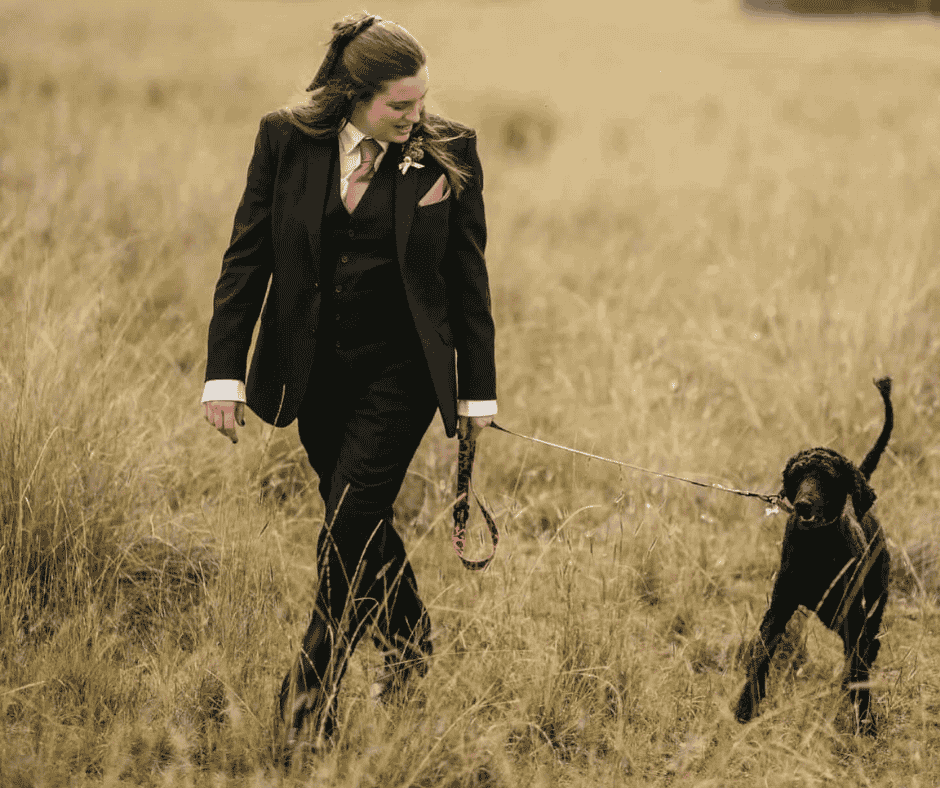
Image: Laura & Maggie thriving in the great outdoors